Just a Man in a Park
I made a 100-second video to say I’m open to work. This is everything that went into it, and where AI helped.
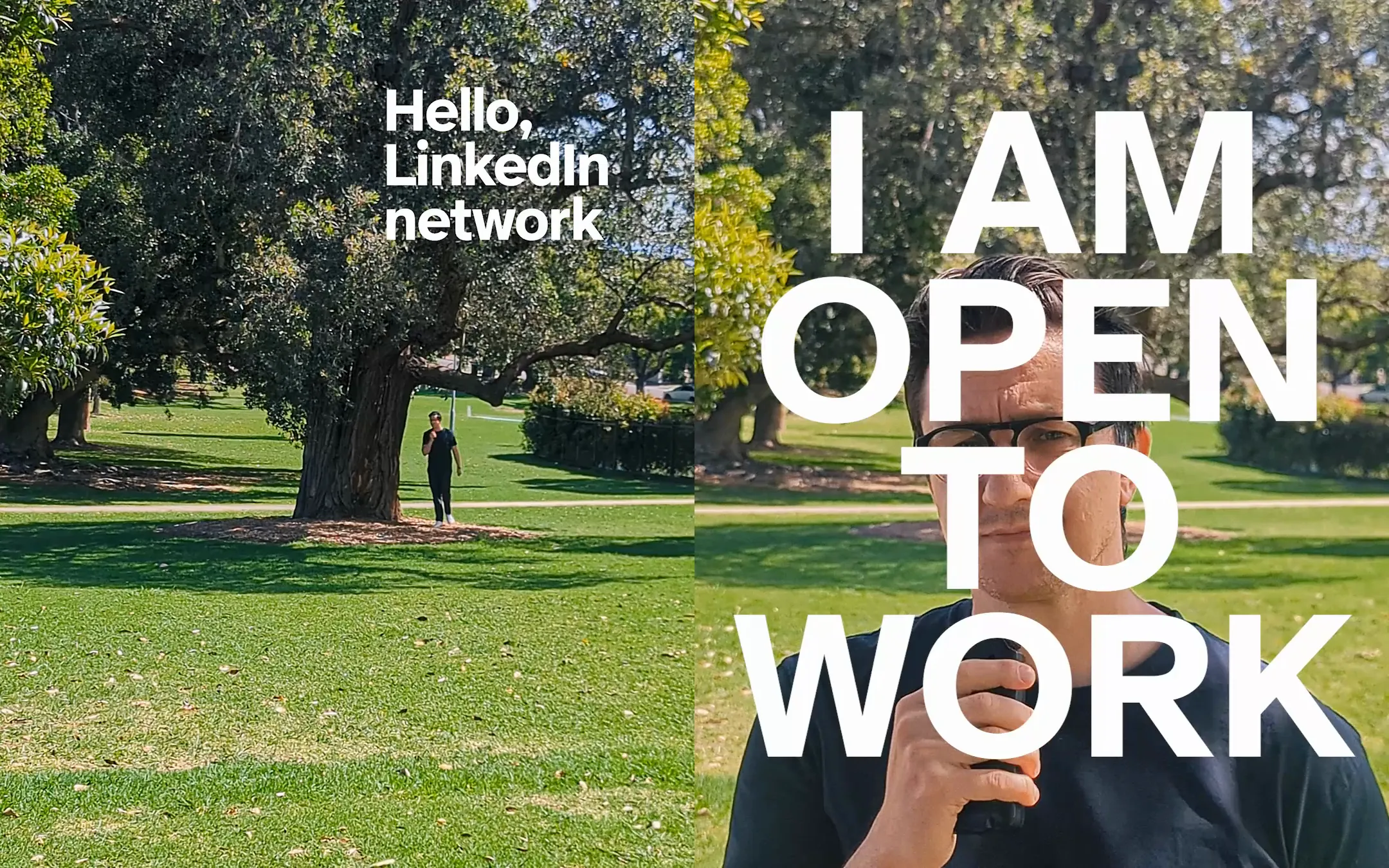
Last week I posted a video on LinkedIn to say I’m open to work. I thought I’d go over what went into a video that no one really wants to have to make.
It’s also on LinkedIn, if you’d like to see the original post.
It’s about as simple as a video gets. One shot of one man in a park. It also took two shoots, a rehearsal in Blender, a cloned voice I didn’t use and 368 colour grades. This is how it got made, and which parts were me and where I leaned on AI for help.
The plan
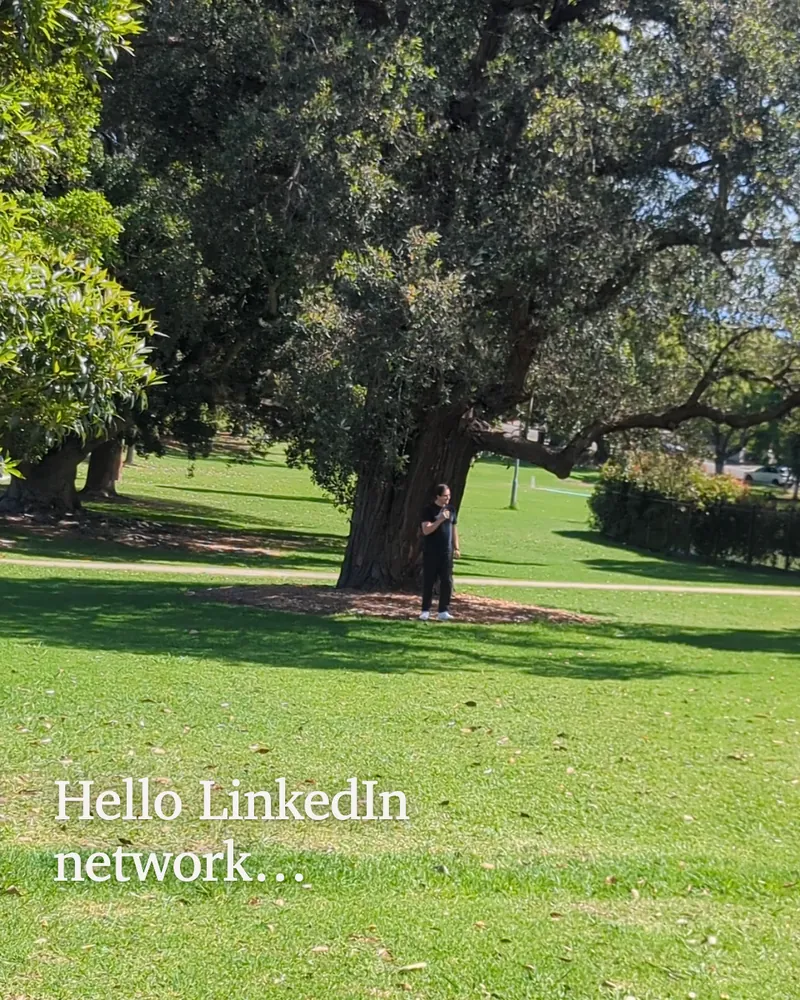
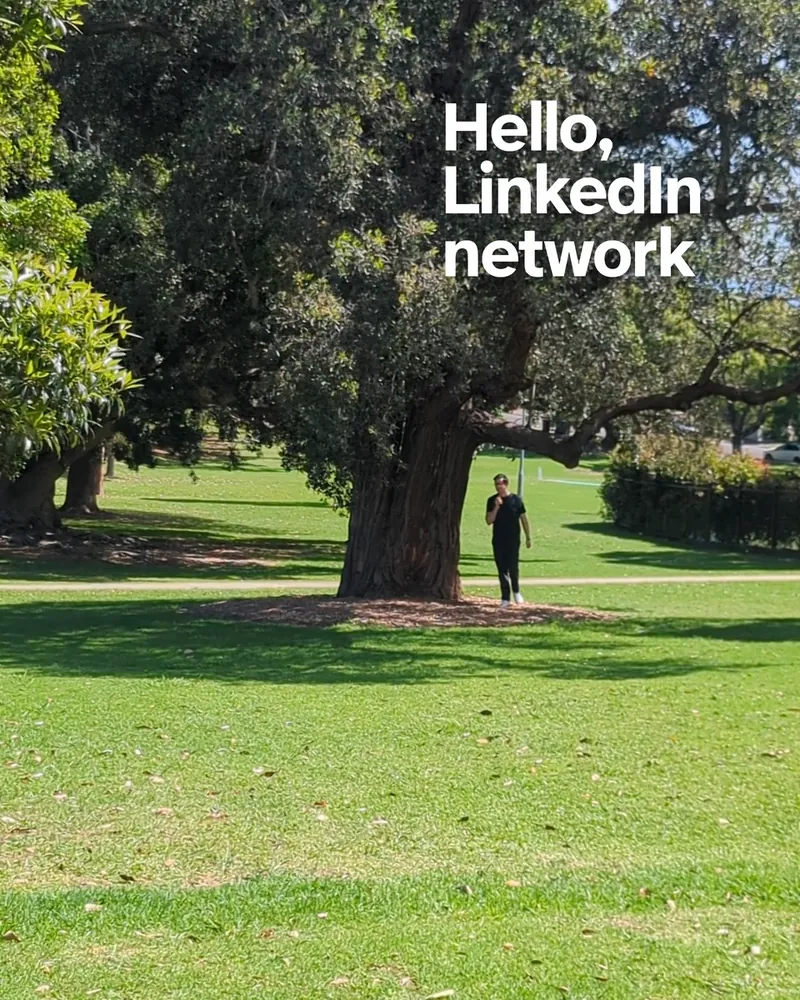
The idea came first. I was sitting in the car, waiting for my partner to collect our kids from school and mulling over my imminent unemployment, when it popped into my head. An ordinary man in a park, deadpan, ambling up to the camera, against music of enormous force and beauty. Something you don’t see on LinkedIn that often. The stare at the end is a nod to the last shot of Portrait of a Lady on Fire, as I remember it: one long close-up on a face while Vivaldi’s storm washes over it. It’s an amazing film. Also I liked the idea of becoming the profile picture, putting on the #OPENTOWORK ring in video, instead of just a static image.
I wrote the script and a brief for each part of the job, and gave each brief to a separate Claude session. One built a rehearsal in Blender, one tried to clone my voice for a guide track, and one was going to help me write the music. Each of them knew the others’ timings and wasn’t allowed to change them.
Rehearsing in Blender
I didn’t have time to get out and recce the shoot, and I wasn’t going to have long on the day, so I wanted to know where the camera, the tree and I should go before I got anywhere near a park. So Claude wrote a script that built the whole scene in Blender: a flat park with distance markers every five metres, a tree, a mannequin version of me holding a little block for the recorder, and three cameras matched to the Pixel 7 Pro’s 1x, 2x and 5x lenses. It checked the focal lengths against Google’s own spec pages first, then worked out for each lens where I’d need to stop, how far away the tree should be and how tiny I’d look when I stepped out.
At 1x my stop mark was 68 cm from the lens, which is close enough to distort a face, and not in a good way. At 5x the opening shot became a tree trunk. 2x was the one. I’d stop 1.38 m from the lens, the tree would be 34.7 m away, and I’d be about 11% of the frame’s height when I stepped out. It also told me the trunk had to be at least 55 cm wide to hide me, which is the first time I’ve gone tree shopping with a minimum spec.
That’s a lot of planning for a phone on a tripod.
The voice that wasn’t me
The animatic needed a guide track, so I could time the walk to the words before I’d recorded them for real. One idea was to clone my own voice. Claude set up two free, open-source models to run locally on my Mac, so my voice never left the machine, and I recorded reference takes for them to copy.
They came back too Australian and too actorly. I’ve lived in Sydney since 2012, so I’ll take the first one as some kind of compliment. I scrapped it anyway, because it was inauthentic and, honestly, overkill. Instead, Claude transcribed a real take of mine with Whisper, also locally, which gives a timestamp for every word, and cut that into the guide track.
The shoot
The first shoot didn’t work. My tripod tops out at about 1.5 m, so the camera sat well below my eyes and I spent the close-up looking down at everyone. The audio was slightly blown out too. And I didn’t completely love how I look in it, which may be something I just need to get over or get back to run club more often.
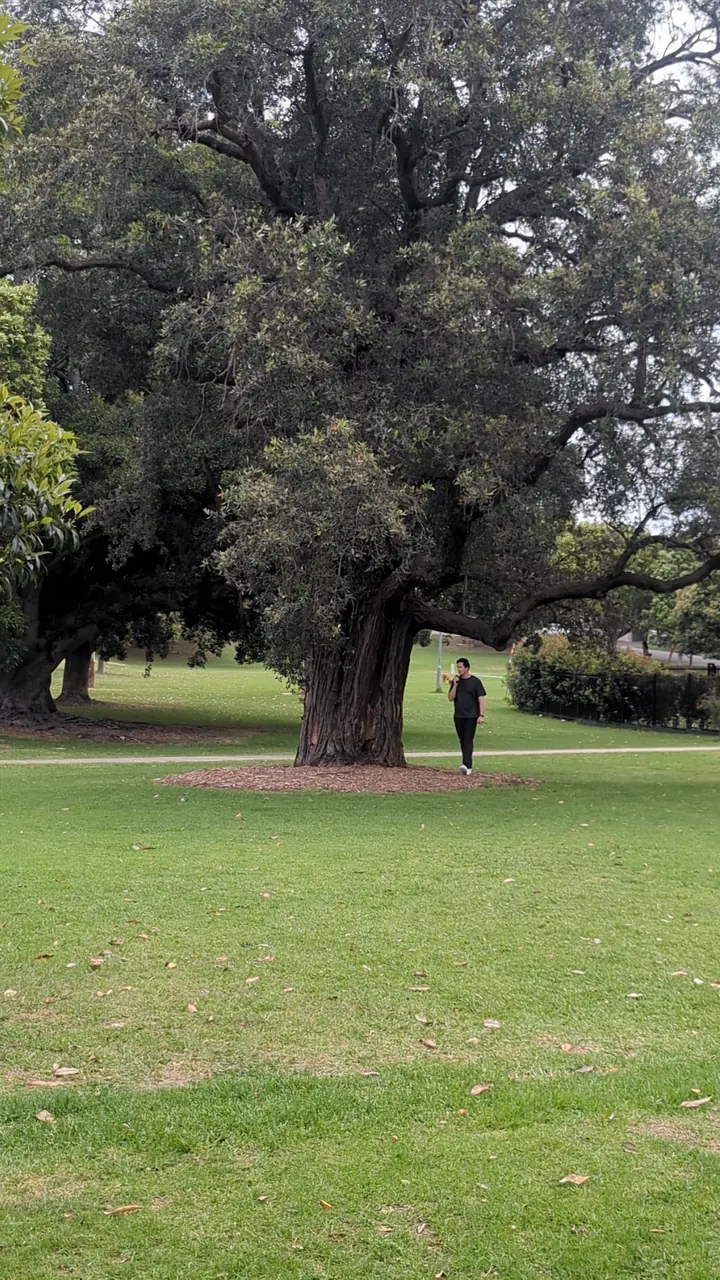
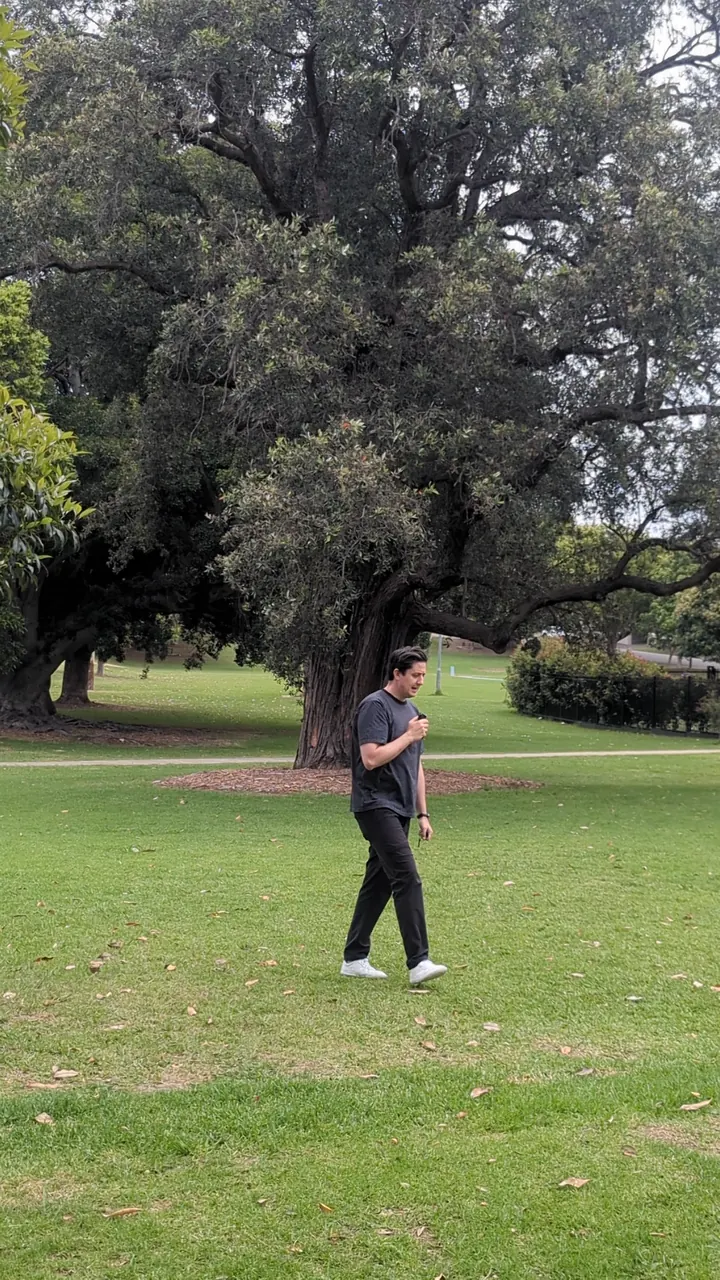
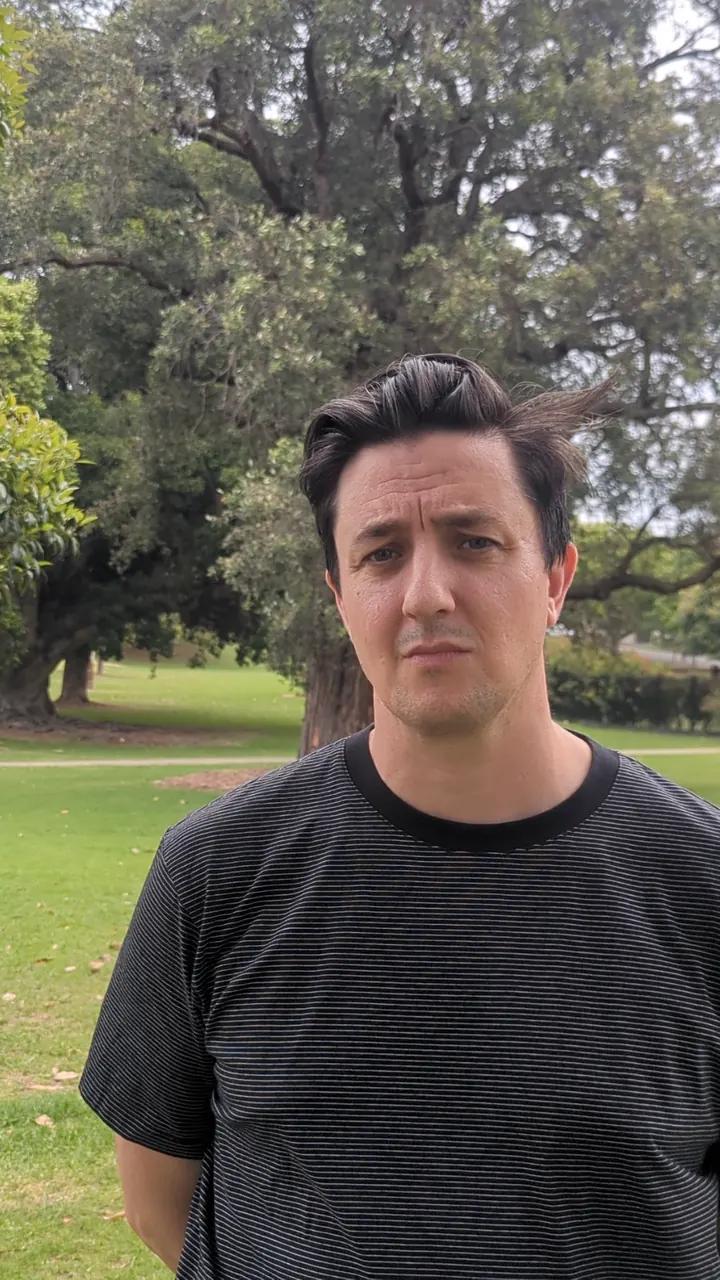
The second shoot was better. The one continuous take worked, with the phone at 2x and me talking into a handheld recorder as I walked. The plan said the walk would take 37 seconds. It took about 63, which felt natural to me. It’s one locked-off shot with no cuts, and I was very happy with the result. It’s different from the original plan, but it’s better.
The music
Straight away I wanted to use Michael Nyman’s “Time Lapse”. Then I thought I should make my own score instead, with a similar energy, written in REAPER with Claude’s help. I wrote a whole brief for it, but that was just going to be too difficult, and I had to get this done quickly.
Originally I considered having the music build up to the announcement that I’m open to work, but it made more sense for it to drop in at exactly the right moment, for maximum impact. I knew I had to go back to “Time Lapse”.
“Time Lapse” is probably the track I’ve listened to most in my life, and I’ve got about 20 years of Last.fm data to back that up. I never get bored of that track. I’m not a massive Michael Nyman fan per se, I like his work, but “Time Lapse” and “MGV” (Musique à Grande Vitesse) are all-timers for me.[1]
Besides “Time Lapse”, I had a few other tracks in mind for the needle drop, and all of them have meant a lot to me.
The closest contender was “Ain’t It Funny” by Danny Brown. It never fails to motivate me. Towards the end of last year we went to Derrick Gee’s Radio Hour at the Australian Chamber Orchestra in Sydney, and he had a section about walk-in music. Without a doubt, this would be my entrance music, if I was walking into a room, or a boxer or a wrestler coming into the ring. But it’s slightly too high-energy, and maybe slightly too menacing, for this video.
“Group Transport Hall” by Women is one of my all-time favourite tracks from one of my all-time favourite bands. I have little daydreams about using it as a soundtrack somewhere, but it’s not right for this. It needs more camera movement and more emotional ambiguity, whatever that scene might be.
“Giving Unknown Origin” by Bill Orcutt is another track I was considering. It’s pretty new, only out this year, but there’s something about the guitar playing and the movement in it that I absolutely love.
“I Saw Another Bird” by Mount Eerie is another song that absolutely stops me in my tracks. The overdriven middle section that builds is incredible. For what it’s worth, this was my daughter’s choice. When I asked her why, she said that to her it just represents me, which is something I never realised she thought.
Ultimately, I had to go with “Time Lapse”. The crescendo, the personal meaning, and the weight and tone it brings to the moment are exactly what I was after. It’s unabashedly me, and I love how it’s worked. You can hear the variations I tried in the video below.
I’m collecting more examples in a playlist.
Fixing it in post
It was windy. Claude measured the shake against the things in the frame that shouldn’t move, the trunk, the hedge and the path, and found about 4 pixels of wobble at delivery size, more while I was talking close to the camera. Stabilising took out about 85% of it and left about 0.6 of a pixel, which reads as a tripod. It also removed a slow creep at the end, where the phone’s lens shifted as the focus pulled onto my face.
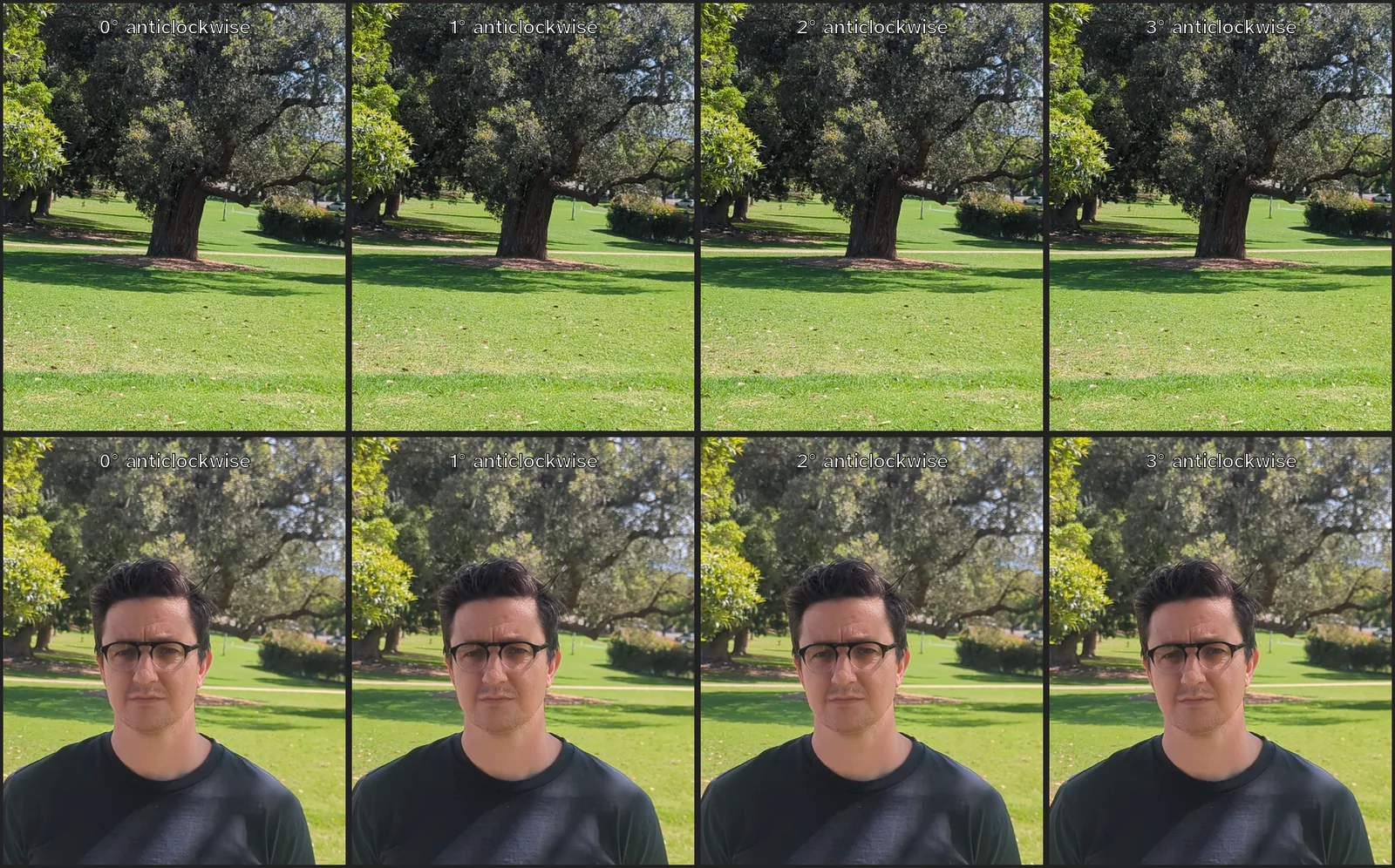
The horizon was off too. The obvious thing to level against was a post in the background, which turned out to lean about 6° on its own, so Claude used the fence posts instead. It made a comparison of the same frames rotated 0°, 1°, 2° and 3°, 3° won, and the levelling and stabilising were done in a single pass so the picture was only resampled once.
The audio was its own problem. The phone had recorded mostly wind, and the recorder had recorded me far too hot, with about 4,300 samples hitting the ceiling. So I re-recorded the voice at home. That fixed the distortion and created a new problem, which is that it sounded like a man in a room. Claude made three treatment tests, one raw, one EQ’d and one EQ’d with wind and saturation, and I couldn’t hear much difference between the first two. In the end I added a bit of saturation and a real wind recording under the birdsong I already had, and on the whole the vocals sound passable. I had to pace about my room to get the right energy.
Type, ring, grade
I wanted the captions in my site’s typography. Claude’s first style frames used Charis, the serif from my homepage intro. Then I decided the captions should build word by word as I say them, and switched to Hyperreadable Neutral Bold, the typeface I use for my name, because it’s more legible. I timed every word myself in Premiere, 108 caption blocks making 24 phrases, and Claude turned my timings into the overlay. The exception is “I am open to work”, which goes huge, all caps, and fills the frame.
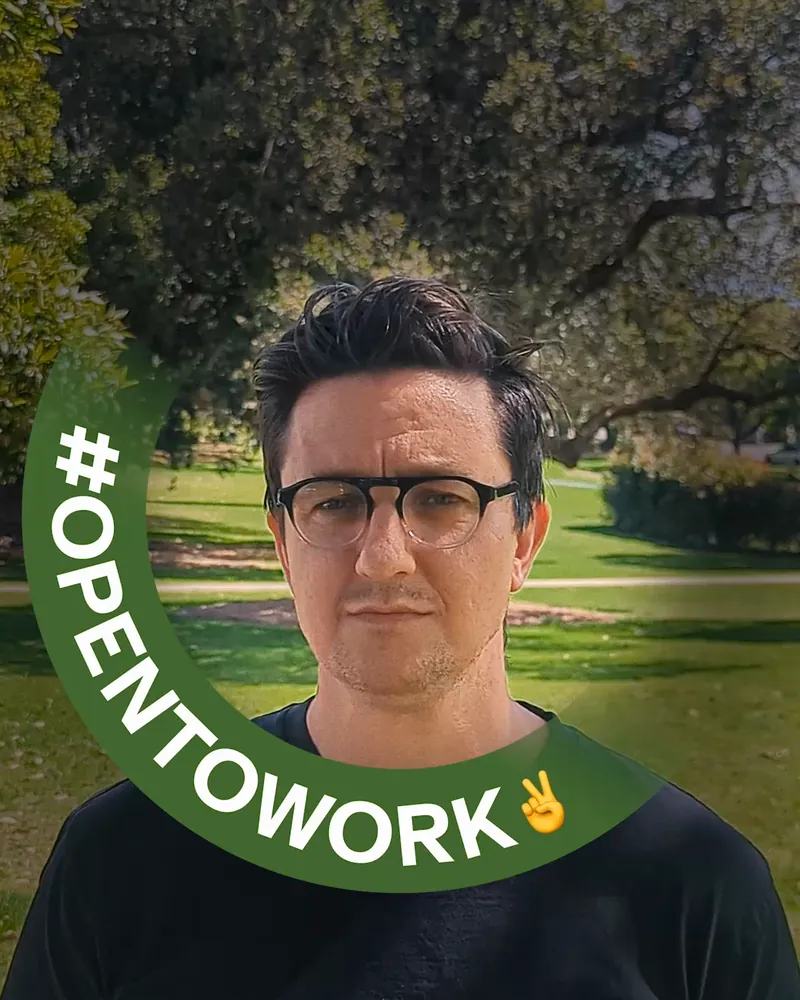
The #OpenToWork ring started in Figma. The plan was to bring it into After Effects with the Overlord plugin, but text on a curve doesn’t survive the trip, and neither did the emoji, so it went in as a PNG. Claude set up a radial wipe to draw it on, I did the easing, and a black mask fades in with it so the frame ends up looking like a LinkedIn profile picture. That’s the point.
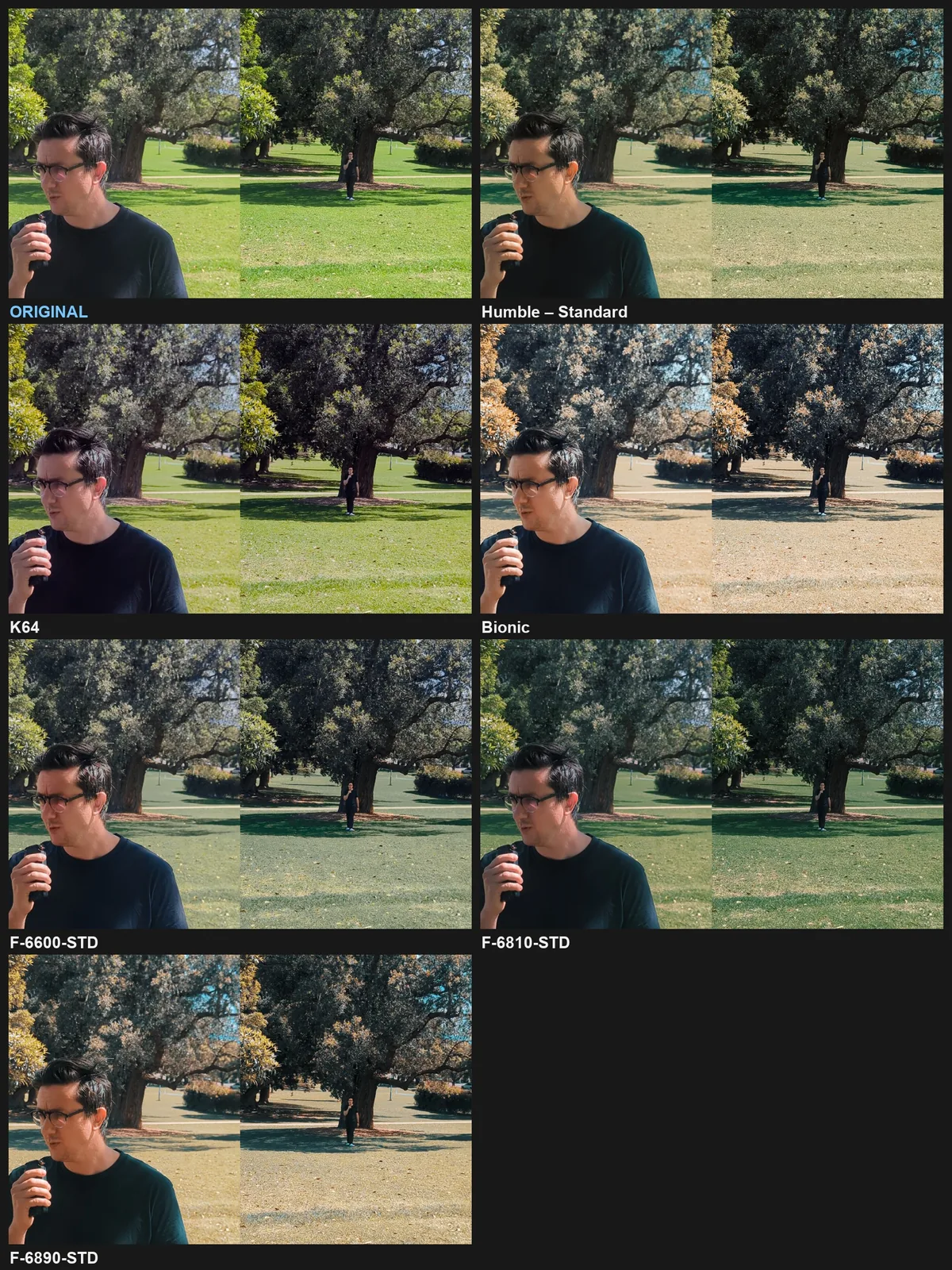
I’ve been collecting LUTs for a while, and Claude put every one of them on my own footage, all 368, across 15 contact sheets, with a close-up and a wide shot in each tile. We got it down to a shortlist of seven, then two, Humble Standard and F-6810. In the end I finalised the look by hand in the Premiere Pro beta, because its new colour mode made the look I wanted much easier to get.
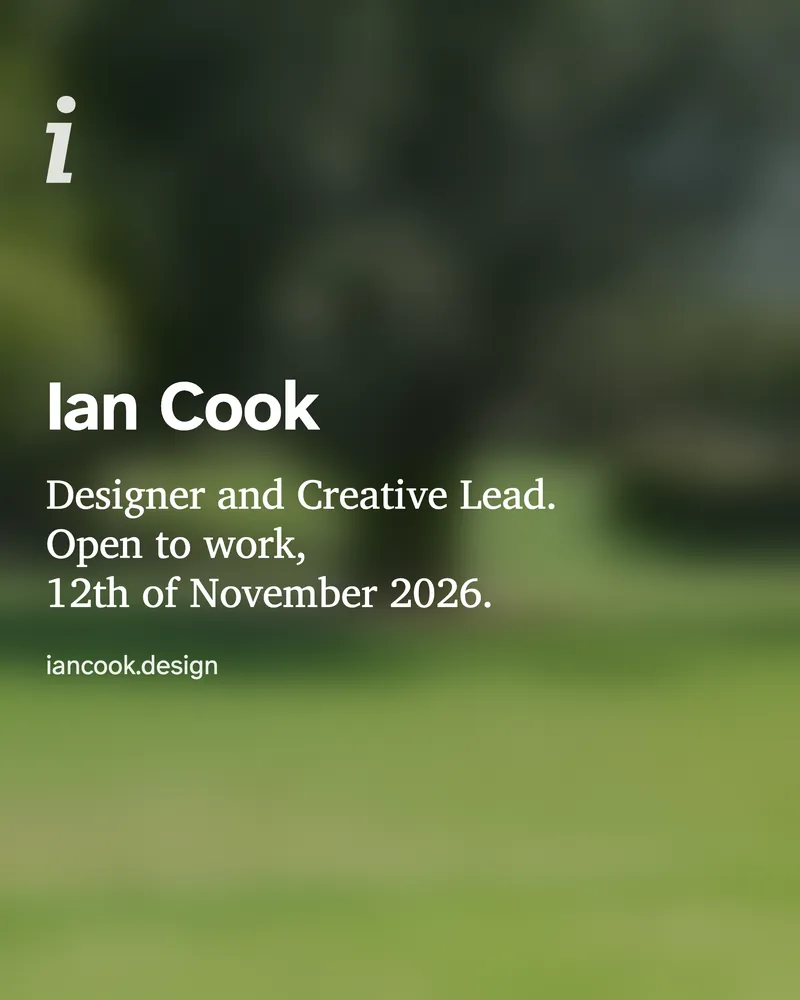
The end card is the blurred park, my name, “Designer and Creative Lead.”, “Open to work, 12th of November 2026.” and the i from my site. Claude built it in After Effects to my spec.
What the AI actually did
Claude did the maths, the measuring and the checking. It worked out the lenses and distances, measured the shake, made the contact sheets, rendered the overlays and checked the export for loudness and length.
The idea was mine, and so were the script, the performance, both shoots, the voice, the caption timing, the movement of the #OpenToWork ring and the edit. I made every choice.
Some of it was fiddly. Claude was connected to the Premiere beta, which couldn’t read my caption tracks back, so I exported them as files. Dynamic Link between After Effects and the beta didn’t work either, so the ring and end card came across as rendered files with transparency.
AI worked perfectly as a process tool for me here, not a creative tool. It let me get through a lot of this faster than I could have otherwise. The only generative AI in the whole project was the voice clone, and I scrapped that almost straight away.
I had fun making this, even though I didn’t want to be in the position where I had to make it. I’m still open to work, by the way.
Both come from movies. I came across “MGV” in The Last Black Man in San Francisco, and the use in that absolutely blew my mind: one of my favourite uses of music in a movie ever. I’d been listening to “Time Lapse” for about 10 years before I saw the movie it was first used in, Peter Greenaway’s A Zed & Two Noughts. ↩︎