Everyone Else Is Doing It: The Lance Armstrong Defence
Lance Armstrong said he doped because everyone else was. I’ve been wondering whether AI is design’s version.
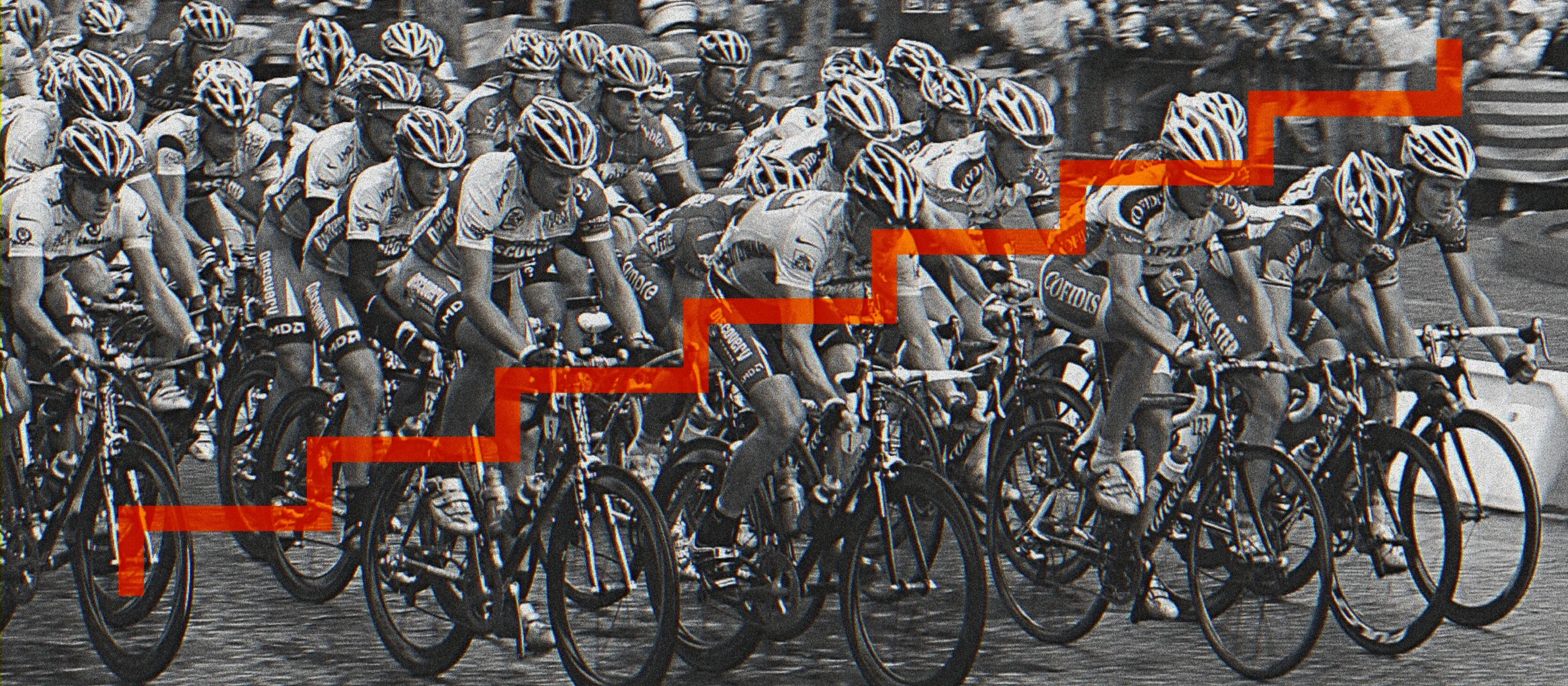
Based on the final stage of the 2005 Tour de France in Paris by Frank Starmer. Cropped, converted to black and white, with added texture and an orange line. CC BY-SA 2.0.

Another week, another post about AI. I’ll admit it’s hard to think or write about anything else at the moment, and over the past couple of weeks I’ve used it more than ever. I’m still sticking to my old tenet, though. The tools I’m using, Claude Code and ChatGPT, aren’t the ones coming up with the ideas. I’m not asking them for ideas and sending those on to people. I’m directing them, and feeding them references, assets and guidelines I built myself.
We’re now at a point where most of what they produce is usable. I can almost never use it straight out of the box, but with a lot of imagery and slide layouts they get me at least 75% of the way there. Video editing and motion graphics, which I’ll come back to, have taken a huge leap too.
What I’m still trying to reconcile is the tension in all of this. I’ve just started listening to an episode of the 404 Media podcast about AI companies scraping the web and what it’s doing to the human internet. Every time I use AI, is that what’s being referenced? Am I complicit in plagiarism every time I hit enter? I don’t know how I feel about that, and I don’t really know how it works.
Then the other feeling bubbles up. If I stop using AI, do I fall behind? Will it be harder for me to find work in the future? Would stopping actually do me harm?
It reminds me of cycling. Five years ago I honestly didn’t give a shit about cycling. I’d never been much of a bike person. My partner grew up in France, so she had a mild nostalgia for the Tour de France, and then we came across Tour de France: Unchained on Netflix.[1] There’s obviously some artistic licence in how they shape the narratives, but it was incredibly compelling. It’s absolutely insane to watch human beings put their bodies through that.
We watched a couple of seasons, then watched the Tour itself that year, and it got me thinking about what I actually knew about the sport. Like most people, what I knew was mainly Lance Armstrong and his downfall. I got interested enough to go looking for books, and found one by one of his teammates, Tyler Hamilton’s The Secret Race.[2]
Beyond how insane it is to ride at that level, the most interesting thing in it was the doping. If you weren’t chemically augmenting yourself, you stood no chance, because the top riders were all doing it. Everyone knew it was wrong, and if you stayed clean you still weren’t going to win. Some riders went to absurd lengths. Look up blood bags if you’ve got the stomach for it.
I see a connection with AI, which is starting to look a bit like doping. It doesn’t automatically make the outcome better, but do you fall behind if you refuse a tool that makes you more efficient? Maybe it’s a case-by-case thing.
Somewhere between drafts of this post, I listened to an episode of Everything Is Fake (and Nobody Cares), a BBC podcast by Jamie Bartlett that I dip in and out of. The episode happened to be called “The Lance Armstrong Defence”.[3] It’s about cheating, and what we choose to call it. Bartlett talks to a few people along the way, then lands on Lance and his interview with Oprah, where he finally admitted to taking performance-enhancing drugs. His reasoning was that everyone else was doing it, so if you didn’t, there was no point. You couldn’t compete.
I don’t think design is there yet. We’re still trying it on, seeing how it feels and asking whether it actually works. You could make the case that it isn’t cheating at all, as long as you don’t look too hard at the long-term implications.
One of those implications is a phrase that entered my vocabulary this past week, “cognitive surrender”.[4] I’ve seen it in a few places, and it’s something I’ve talked about with other people. Without the friction and the struggle, do you really build skills and experience? It comes back to how you use AI. If it’s coming up with the ideas, developing them and feeding them to you, or doing the things you don’t know how to do and probably should learn, are you learning anything? If AI got switched off tomorrow, could you carry on with what you’ve been doing?
A lot of people are very keen to jump on every new bump in the trend roller coaster. I know I had a go at Twitter last time, but it really is a raw, almost unbearable place for this kind of thing. Something new comes out and people start shouting from the rooftops. “Motion graphics are dead. Look what we can do now. Here’s the prompt.” It can be unnerving.
I was listening to an episode of one of my favourite design podcasts, Works But Makes Noises, in an episode about sell-out culture, and they talked about how the latest generation of designers is much more open to selling out. They’re happy to do what they need to get paid and get themselves out there, shilling themselves all over social media and flogging their wares. Slightly older designers have never really been about that, and it makes them uncomfortable. There’s a scarcity element too. There are only so many clients out there, so if I’m not putting myself out there, how am I going to be seen? That drives a fair bit of anxiety in some people.
The whole conversation has a fragile, tense atmosphere, and it will probably have flipped on its head by this time next week.
I keep asking myself whether AI is cheating. My first instinct is no, because the output is the output. Then I remember that the AI is making the output, and I have to think again. If you’re using AI to make work that beats other people to jobs or pitches, is that fair? Then again, what does that say about the people choosing based on that work?
For my part, I’m going to focus on my own shit. The ideas and the things I make are all me, and always have been. What excites me is that AI now lets me talk to the tools I already use. It’s almost like waking up and realising how convoluted some of them are. After Effects can be a pain in the arse, which is why there are about a million plugins for it.
Now I don’t have to twiddle through property menus or hunt for a plugin. I can tell Claude what I’ve done before and what I want, and it does it while I get on with something else.
Two simple updates that would have been a fiddly pain in the arse to do by hand. With Claude it takes seconds.
Using Claude, I updated and repurposed an After Effects project from last year in a few hours instead of a day or two.
That’s a win. The ideas are the same, and they still come from me. I’ve just got a tool that helps, and nobody’s going to strip me of a title for skipping a plugin.
Made by the same people behind Drive to Survive. It ran for three seasons, covering the 2022 to 2024 Tours, and Netflix has called it a day since. ↩︎
Written with Daniel Coyle and published in 2012. Hamilton rode alongside Armstrong for the first three of his seven Tour wins, so he was well placed to know. ↩︎
It went out on BBC Radio 4 in April 2026. Bartlett describes the defence as the quiet logic of “everyone else is doing it, so why can’t I?” ↩︎
The term comes from Wharton researchers Steven Shaw and Gideon Nave. In their experiments, people accepted the AI’s answer 80% of the time even when it was wrong. ↩︎