A Very Fast Pair of Hands
Someone asked me how I’d been using the Webflow MCP. Answering them made me realise how much five weeks of it had actually covered.
Based on Movement of the hand, a hand drawing a circle, photogravure after Eadweard Muybridge, 1887, Wellcome Collection. Cropped, with orange bars added. CC BY 4.0.

A few weeks ago I mentioned the Webflow MCP in a Slack channel in the Generate community. I didn’t think much of it. Then someone messaged me on LinkedIn. They’d seen the post, they’d had a bad experience with the MCP, and they wanted to know how I’d been using it and whether I could help.
It was a fair question, and I realised I’d never actually stopped to answer it, even for myself. So I went back through everything I’d done on Vouch’s website since the start of October and wrote it up for them. Once it was all in one place, it blew me away a bit. AI has completely changed my process in the past six months, but I hadn’t put this part of it into context until someone asked.
What five weeks covered
The MCP lets Claude talk directly to Webflow. I use it through Claude Code, so Claude can read the site, plan a change, build it and check it, while I review everything and do all the publishing myself.
In about five weeks that covered Vouch’s 80+ pages and 400+ blog posts. We checked around 58,000 links and fixed about 4,700 of them in the blog, rebuilt 150+ redirects so every old address lands in one step, and gave more than 1,100 images alt text. Claude looked at each image and wrote the description, which is the kind of job that never gets done by hand because nobody has a spare fortnight.
The audits turned up plenty too. Any site that’s been growing for a few years collects problems nobody can see, the kind that slow pages down or trip up search engines, and most of what we found was fixed the same week.
The blog got a proper reading layout, with body text up from 16px to 20px and lines cut from about 91 characters to 66, using two typography books as the brief. Around 8,100 straight quotes and spaced hyphens became curly quotes and en dashes. Each CTA card in the blog can now carry its own animation, which went from a prototype in the morning to staged on the live site by the evening. There’s a converter that turns my animation handoffs into embeds for page heroes, and a little tool that makes the header, thumbnail and tile for a customer story in one go. I also ran a house spelling pass, converting stray UK spellings to US across the site, because that’s Vouch’s style.[1]
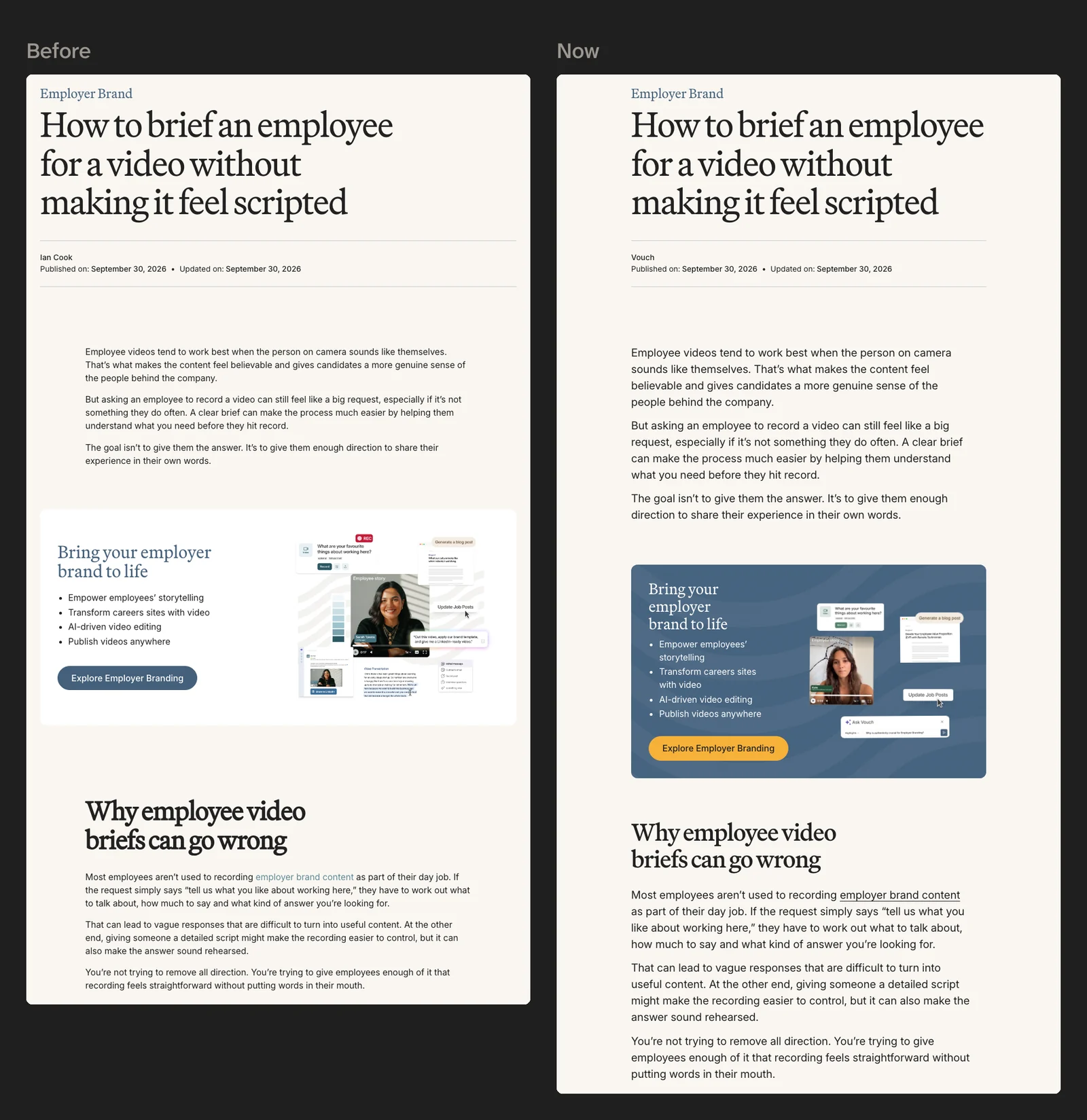 Same post, before and after.
And because it was there, I asked whether we could make a joke version of our demo page. The longer you stay, the more “Book a demo” buttons appear, with one stuck to your cursor, and the copy gets needier as it goes (“Book a demo (please)”, “We can see you scrolling”, “Book a demo. We miss you.”). It took one conversation to build.
Here’s the Needy Book a Demo button at 2× speed.
All of it has significantly cut what Vouch spends on development maintenance. And all of it happened in about five weeks, which still doesn’t sound right to me.
How it stayed on the rails
Speed is great until it’s fast in the wrong direction. Before any of this, I pointed Claude at Lumos, the Webflow framework we build on, plus our style guide, components and design system, so everything it built was grounded in what we already had.
Then a few rules. Anything new gets built on a duplicate of the site first. Every bulk change starts with a full backup so it can be reversed, and over five weeks that came to more than 100 of them. Bulk edits get a dry run, then go onto three test posts for me to check, then run on everything. Claude checks its own work in a real browser at desktop and phone widths, nothing gets deleted without a yes from me, and Claude never publishes the live site. Every change was directed, staged, reviewed and logged, and I’m the one who presses publish.
It’s a very fast pair of hands, and I’m still the one deciding what they do and how they do it.
If it was painful last time
This is roughly what I told the person who messaged me. My first attempts were frustrating too. Asking for a whole page in one go, in a plain chat window, mostly made a mess.
What changed it for me was using an agent instead of a chat. Claude Code can write and run scripts, take backups and open the page in a browser to check its own work, and most of the big numbers above came from scripts rather than one-at-a-time edits. Keep the Webflow Designer open with the MCP app running, because a lot of “it just failed” moments come down to that. Ask small and specific. “Fix the heading levels on this page” works, and “redesign the homepage” doesn’t.
When it hits a Webflow quirk, have it write down what it learned so it doesn’t make the same mistake twice. When it hits something it can’t do, like placing elements inside a component’s slot, spend 30 seconds doing it by hand. And if you want somewhere safe to start, ask it to explain your site. “List my components and where each one is used” only reads, so nothing can break, and you learn how it sees the build. Fix one blog post next, and only go bulk once that one looks right.
What it opened up
I really enjoyed being able to give something back. Someone was having a bad time with a tool I’d been having a great time with, and I had a real example to show them in place of a vague “you’ll get there”.
AI is a process tool for me, not a creative tool. What’s changed is the scale I can apply my creativity at, which is bigger than I ever thought I’d get to, and I’m really excited to see where my way of working goes next.
I’m British. I did it anyway, which says a lot about my professionalism and nothing good about my soul. ↩︎